Swiss Brain Observatory
Designing an application to connect neural circuits and build connectomes
Summary
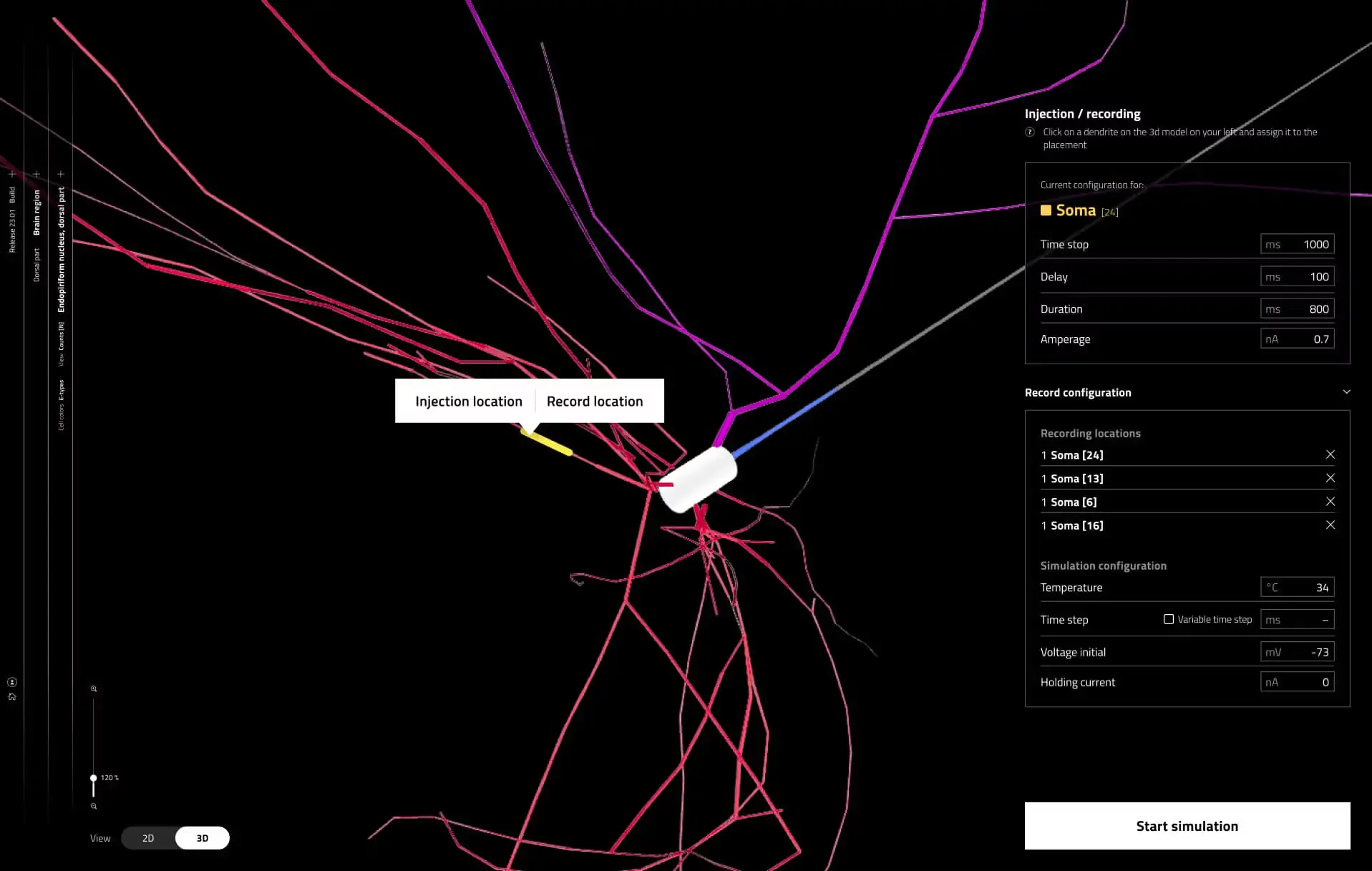
From a long, complex process, rebuilding a digital brain and modeling its electrical behavior, to a guided path to explore, build and simulate, from a single neuron to the whole brain. I ran the user research, with interviews and journey mapping, wrote the product roadmap and designed the workflows, pages and interactions. Workshops put scientists of very different brain regions on common ground, and the virtual lab brought models, simulations and explored items into one place.
Technical sheet
- Year
- 2023
- Role
- Product designer: user research (interviews, journey mapping), product roadmap, workflows, pages, journeys and interactions. Frontend and backend engineer.
- Field
- Neuroscience: connectomes, neural circuits, morphological-electrophysiological models
01
Role
What I owned.
I ran the user research, with interviews and journey mapping, and wrote the product roadmap.
I designed the workflows, pages, journeys and interactions of the application.
I also worked as a frontend and backend engineer.
02
Research
Context and business friction.
- Problem
I started from a long process: rebuilding a digital brain and modeling its electrical behavior, carried out by scientists who specialize in very different brain regions.
- Decision
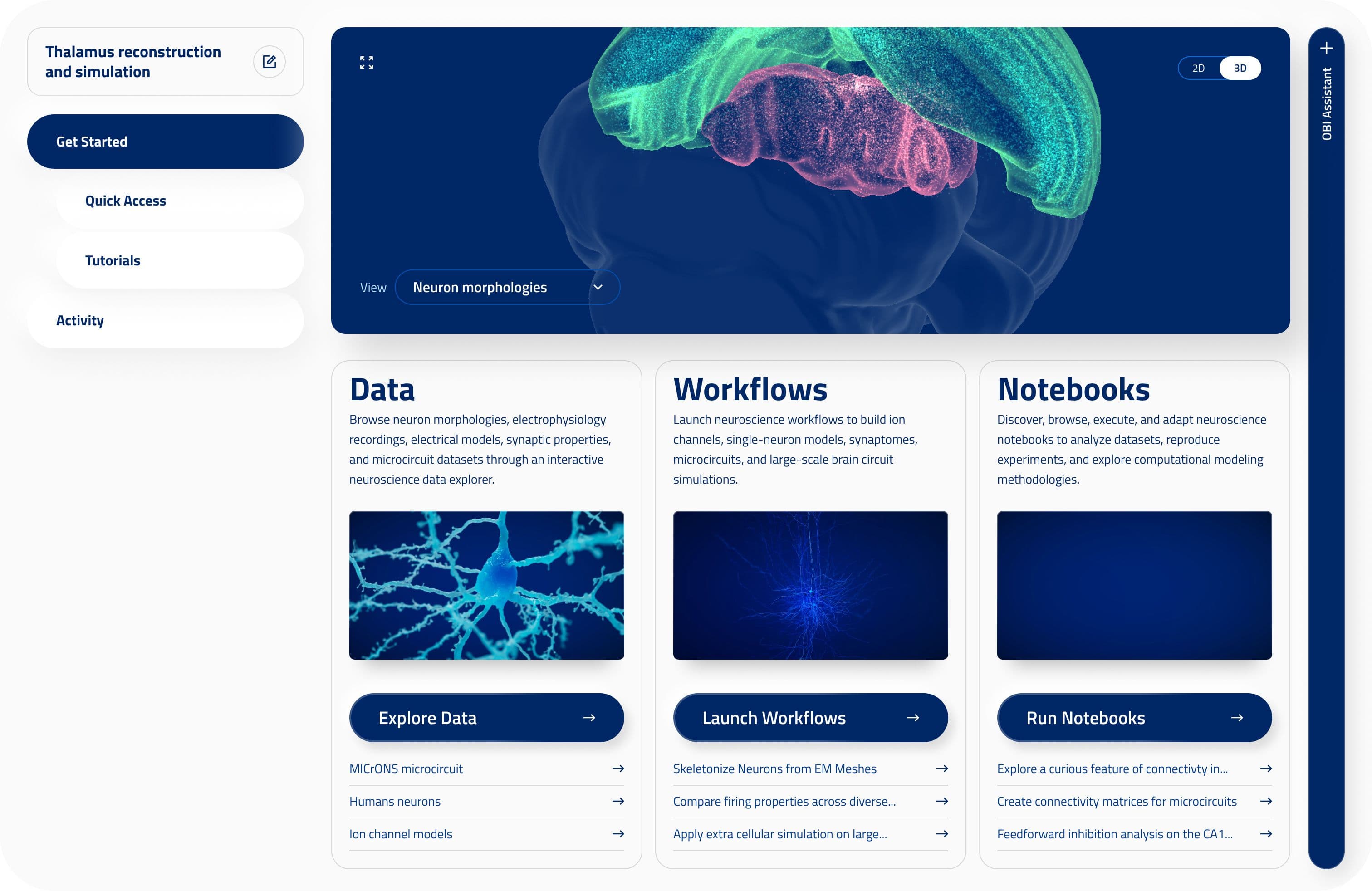
I organized the whole application around three constant gestures at every scale, explore resources, build models, simulate them, then brought them together in a virtual lab.
- Result
I gave scientists one space for models, simulations and explored items, which opens the way to an AI-assisted paper-writing feature.
Field: each scientist specializes in one or more brain regions.
My design: the Swiss Brain Observatory, to connect neural circuits and build connectomes (matrices of the connections between thousands of neurons).
Work: long, at several scales, from single neuron and ion channel to microcircuit and whole brain.
03
Decisions
The key trade-off, and the transformation.
Conflict: scientists from very different brain regions rebuilding a digital brain together; no single model fits all.
Refused: starting from one model, which would leave other teams behind.
Decision: start from workshops where each team explained its daily problems; quick prototypes gave common ground.
Constant through iterations: explore resources, build models at different scales, simulate them.
Result: model-building experiments, simulations and Explore items in one space, the virtual lab.
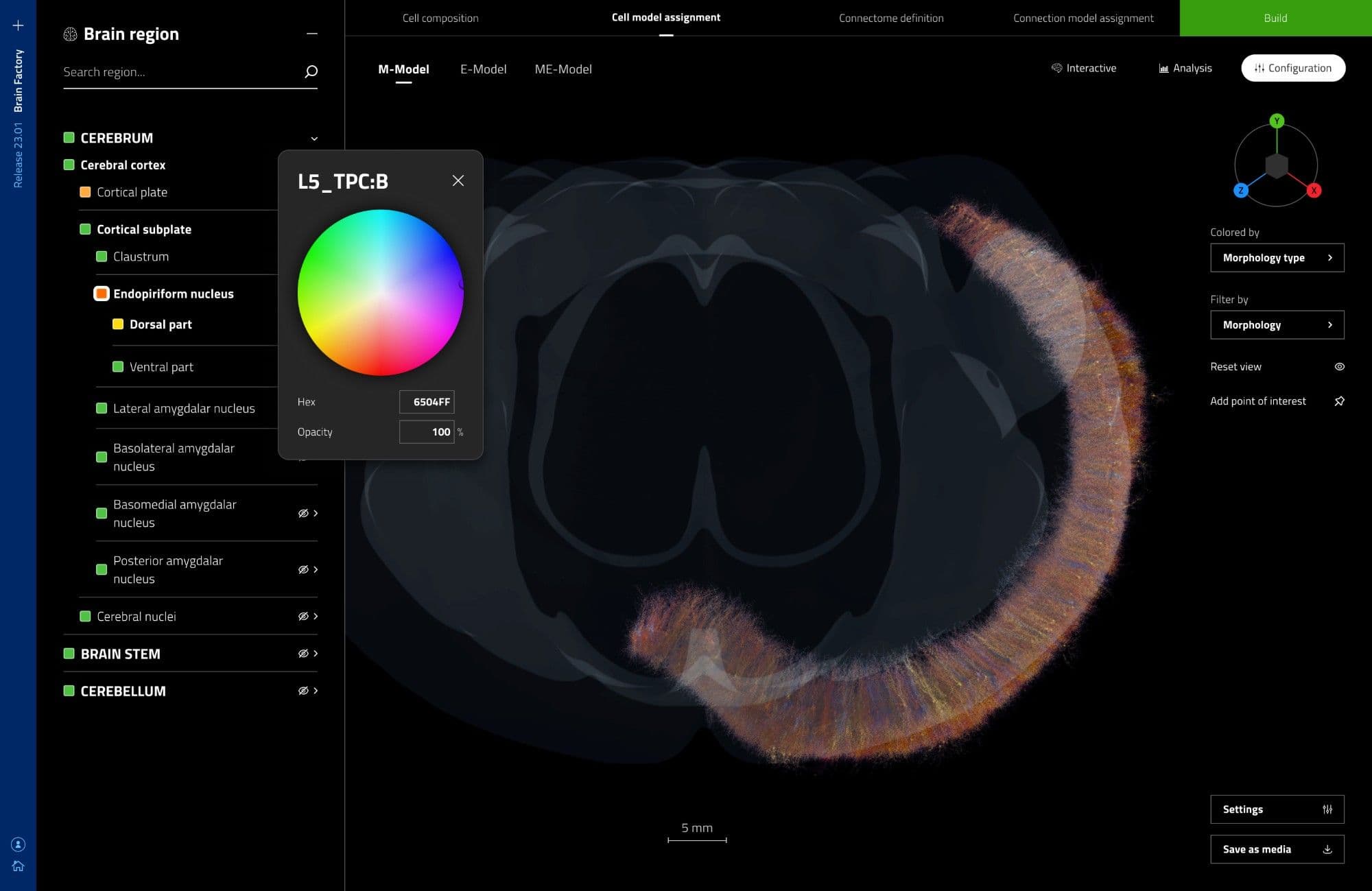
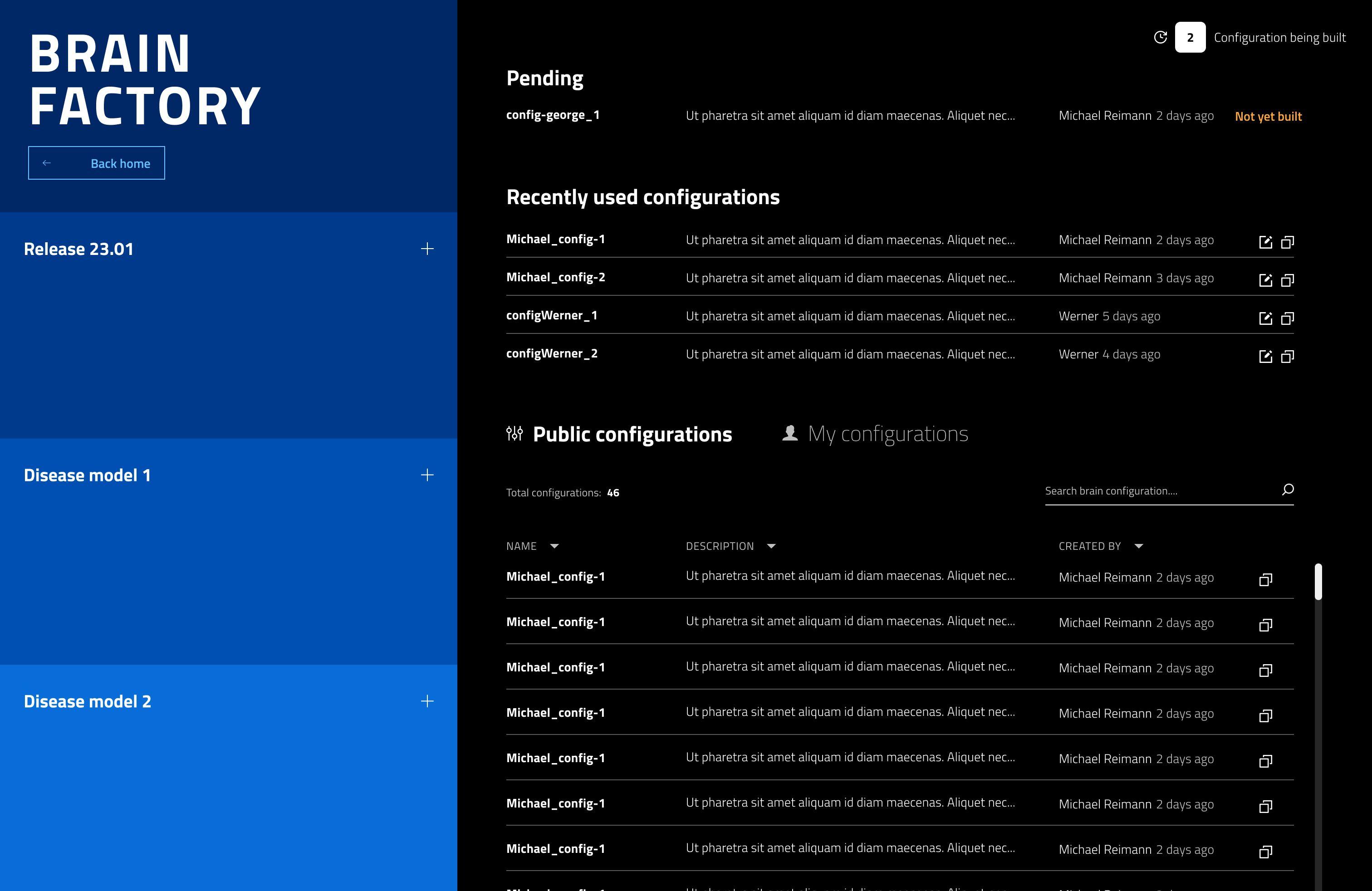
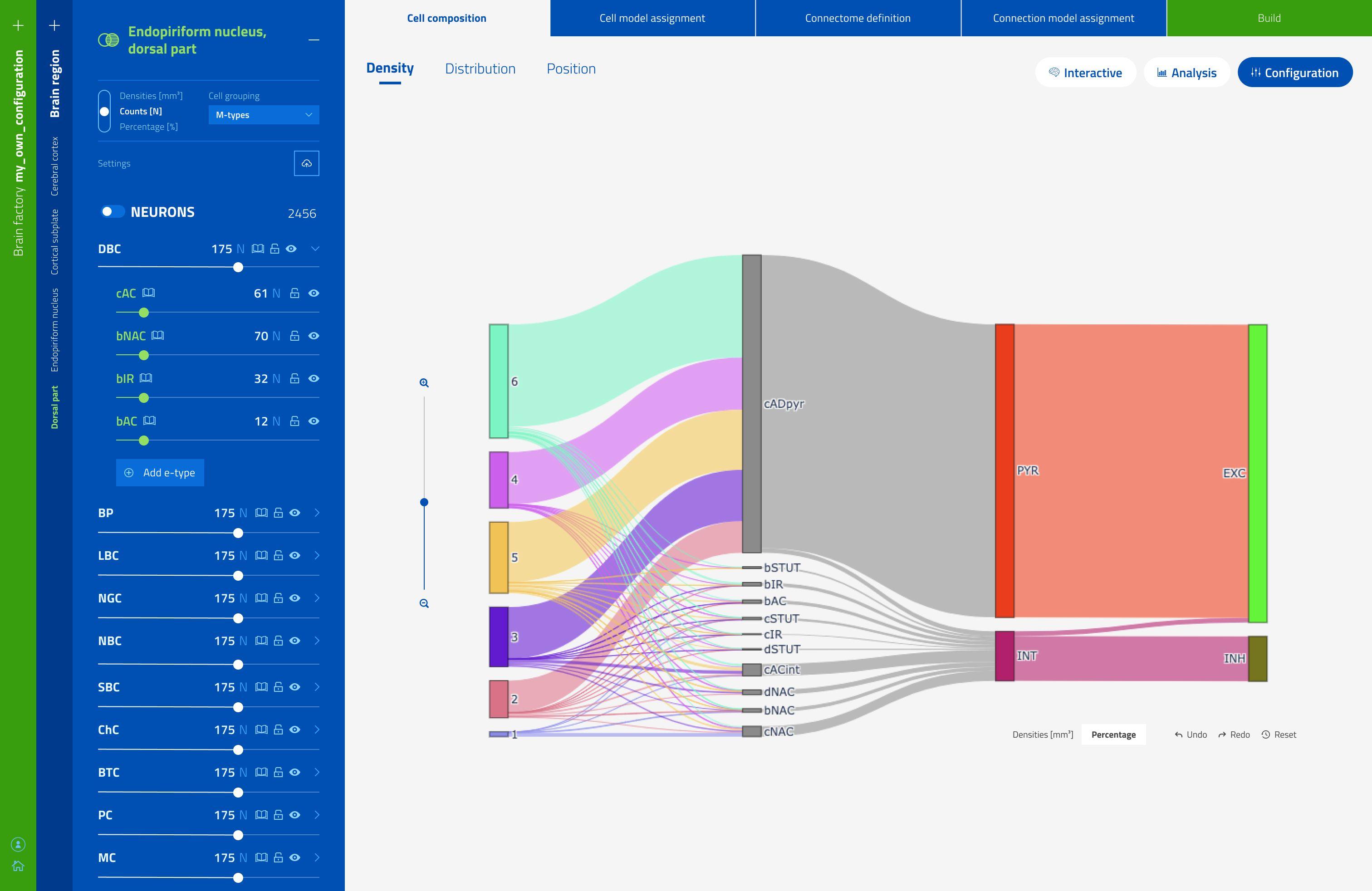
I designed Brain Factory as the place where a digital brain is configured. Its home lists the configurations that are pending, recently used and public, next to the releases and disease models they start from. Inside one, five tabs lead from the cell composition to the build: cell composition, cell model assignment, connectome definition, connection model assignment, build. The first tab shows, as a flow diagram, how the neurons of a brain region divide by layer, cell type and excitatory or inhibitory.
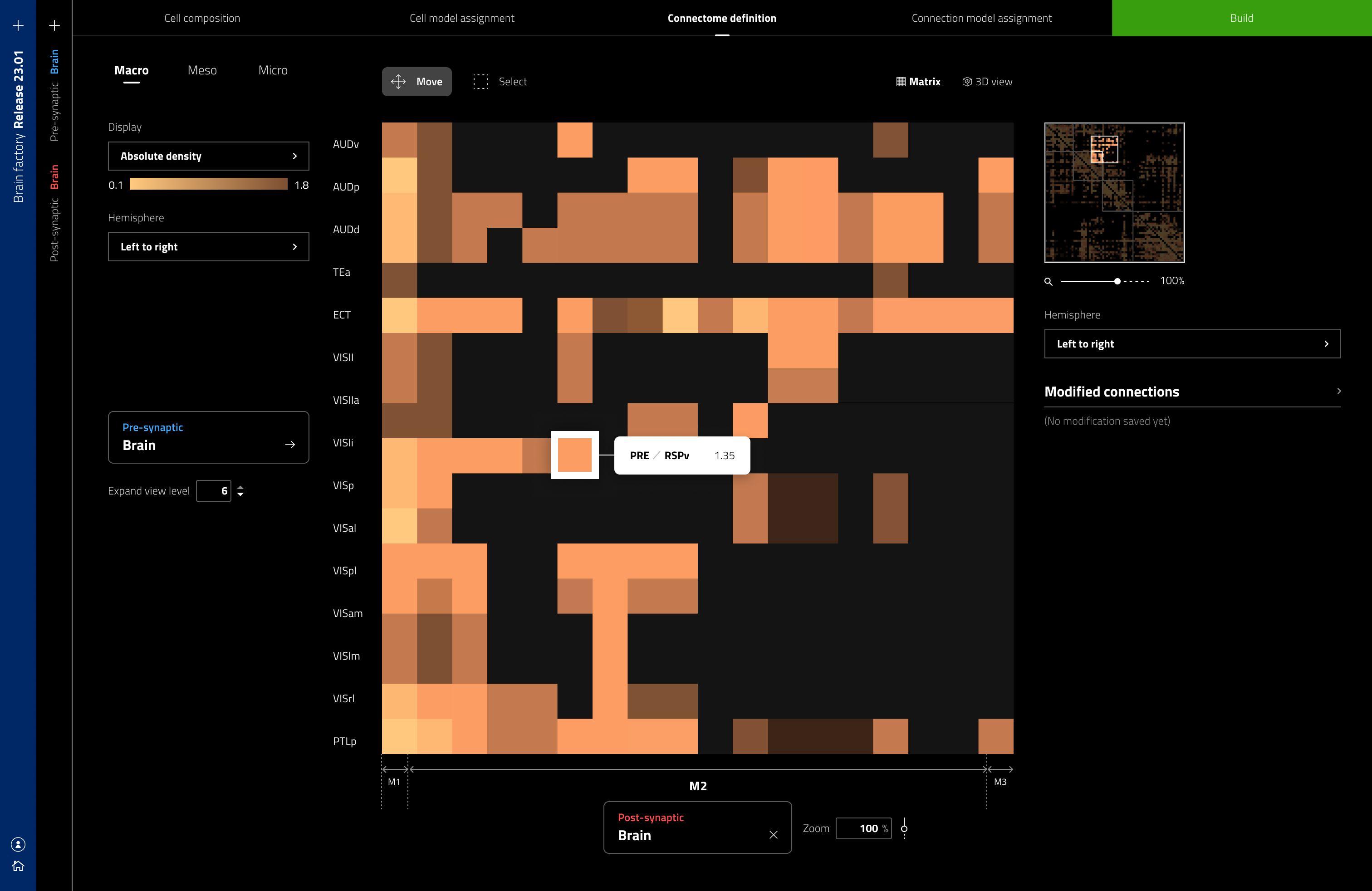
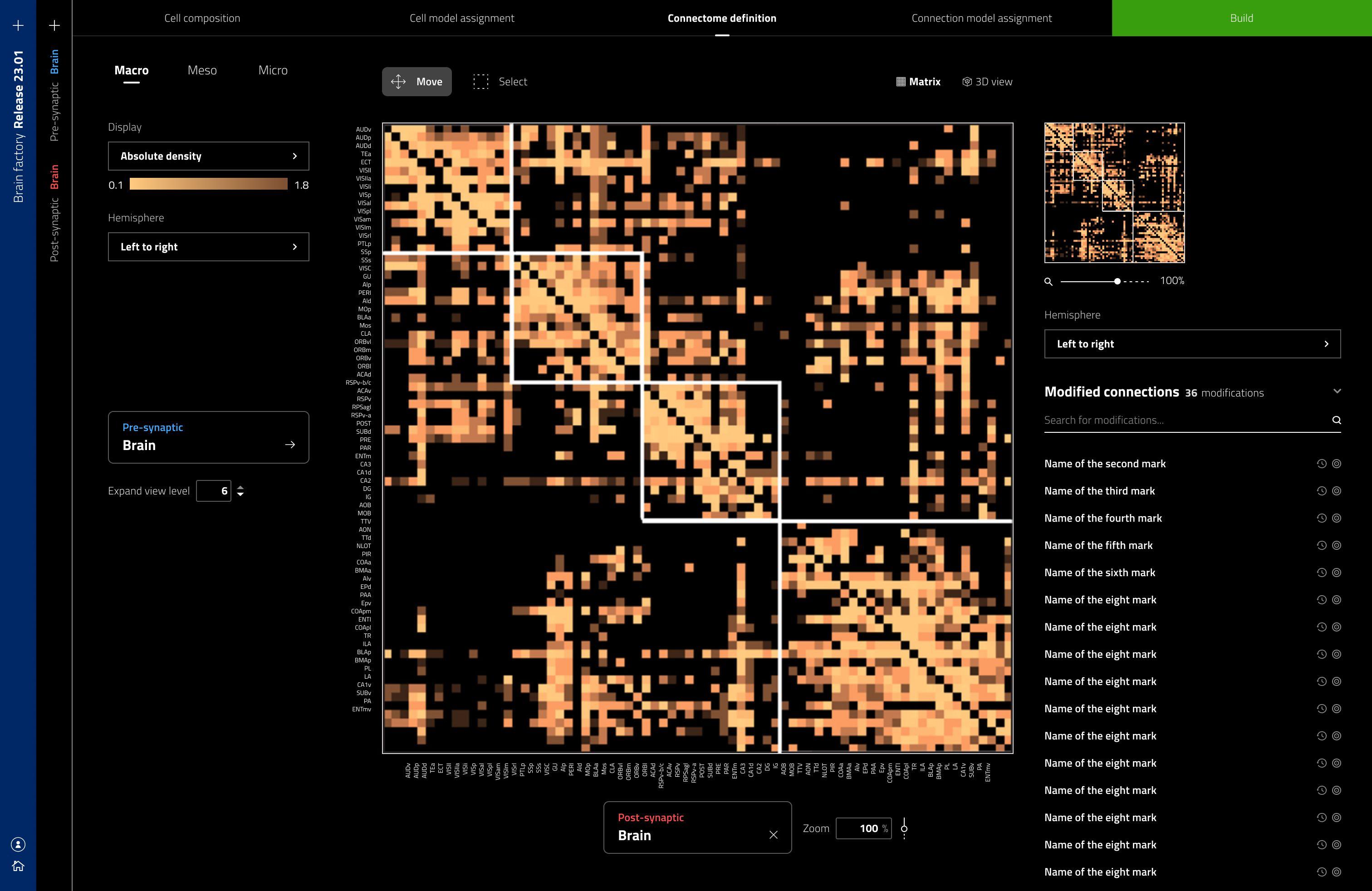
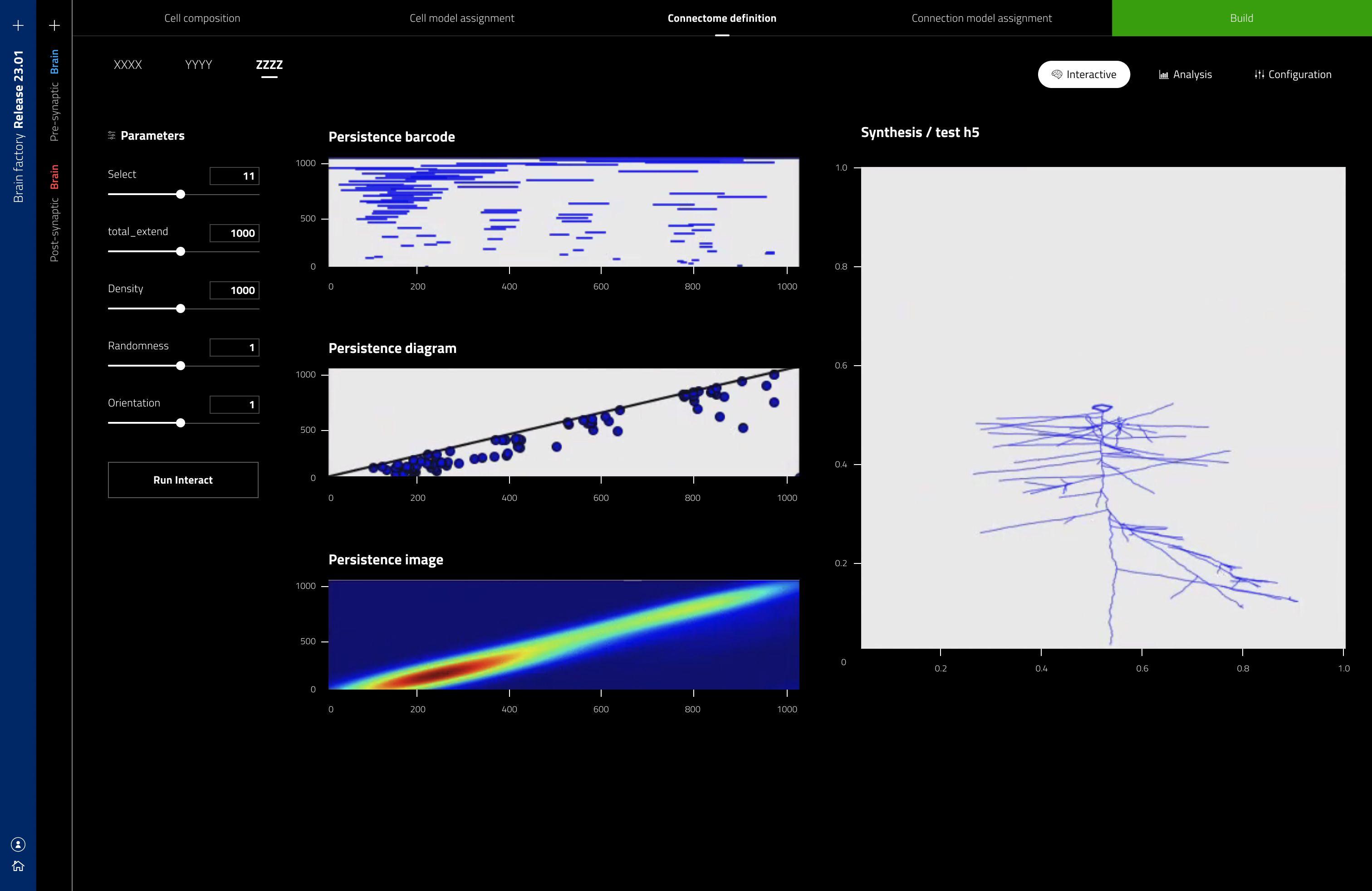
I designed the connectome definition as a matrix of the connections between brain regions, read from the presynaptic side to the postsynaptic one, at the macro, meso or micro level. A color scale gives the density of each connection, a minimap places the view in the whole matrix, and a list keeps track of every modified connection. A 3D view is one click away. Next to it, a synthesis screen runs a model on its parameters and sets its persistence barcode, diagram and image beside the neuron it produces.
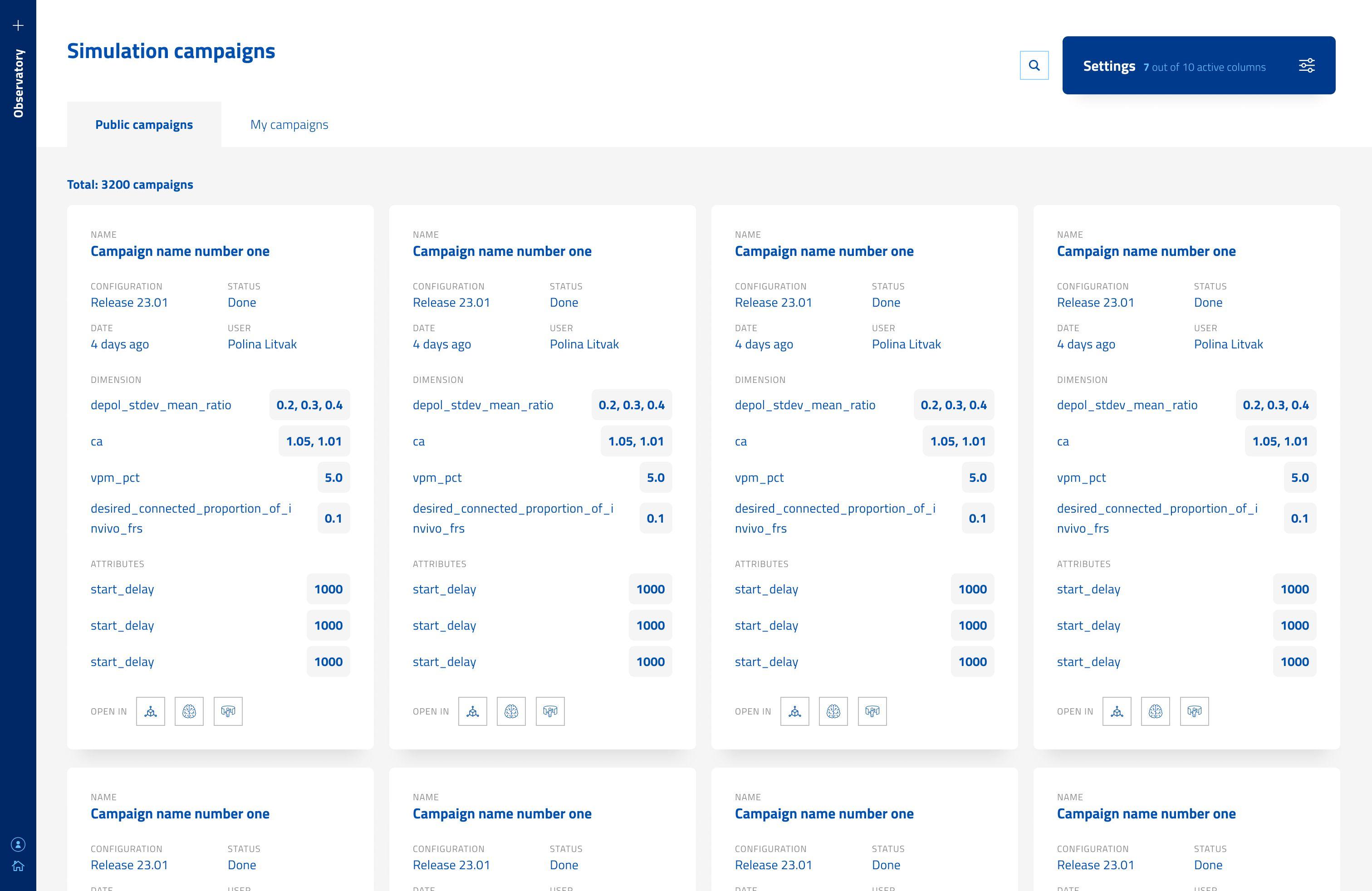
In the Observatory, I laid out simulation campaigns as cards. Each one shows its configuration, status, date and user, the dimensions that vary and its attributes, with links to open it in three tools. A tab separates public campaigns from the user’s own, and a settings button chooses which columns are shown.
04
Impact
Proof, and what I would revisit.
I brought model-building experiments, simulations and the items gathered in Explore into one place, the virtual lab, a single space that opened the way to an AI-assisted paper-writing feature.
I kept users in control of the quality of their analyses and simulations, even massive ones, and an AI literature search complements the atlas to take knowledge discovery further.
The workshops I ran proved their worth: each team enriched the others’ process by exposing its real difficulties. This is the format I bring from the start, with quick prototypes in every session. People who left the Blue Brain Project at the end of their term asked me for the blueprint on how to run the workshop we made to test features, ideas and the app.
Explore case studies
Explore other projects
- LO-OL FoundryA type foundry making typefaces that customers test before they buy, and tools that speed up Korean font design
- EHL SchoolA guided application and program explorer for prospective students
- PartOfA platform that helps neighbours meet and help each other, built around residents’ needs
- NissanOne app for drivers to manage their thermal or electric Nissan
- Patek PhilippeA website rebuilt around each watch’s history and mechanics, and a digital museum
- Smart HangeulAn application that speeds up the creation of Hangeul typefaces by 25%, automating smart components, their variations and the full character set